
SIMPLY 3 FINSERV PRIVATE LIMITED [CIN: U67190PB2022PTC056099] is an AMFI Registered Mutual Fund Distributors & SIF Distributor (ARN-249158)
Lokesh Malhotra [ARN-158405] | AMFI Registered Mutual Fund Distributor
Here’s what could be behind it.
Paying on time is important—but your credit score looks at more than just your EMIs.
Imagine this.
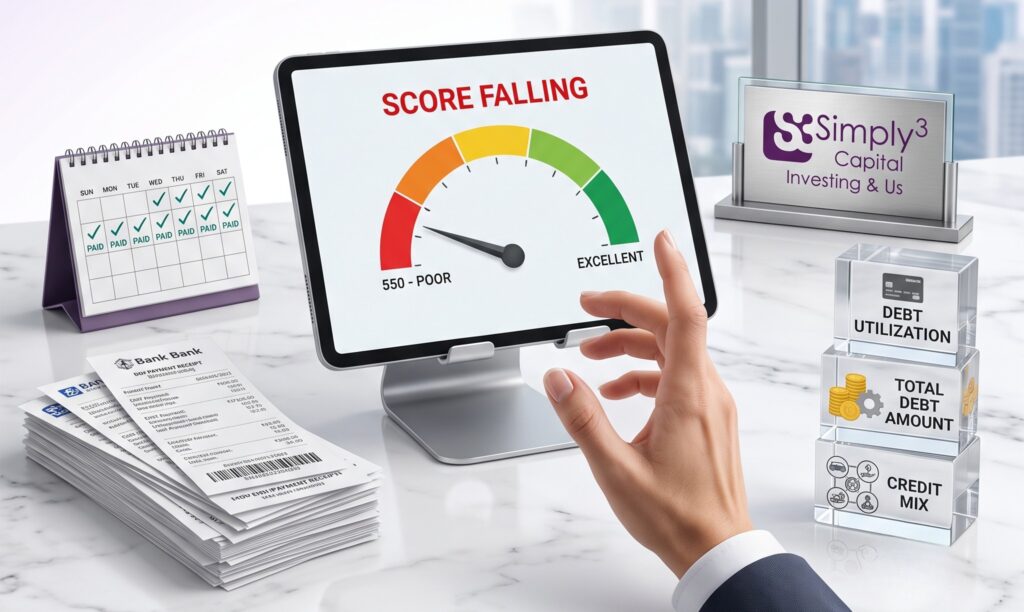
You have never missed an EMI. Your credit card bills are paid on time. Yet, one day, you check your credit score and find that it has dropped.
The first question is obvious: “But I paid everything on time. Why?”
The answer lies in how your overall credit behaviour is viewed.
1. Your Credit Card Usage Matters
Paying your credit card bill on time does not necessarily mean that your credit utilisation is low.
For example, if your credit limit is ₹5 lakh and your outstanding balance is regularly ₹4 lakh, you may be using a large portion of your available credit.
CIBIL identifies credit utilisation as one of the factors that can influence your score. Higher utilisation can indicate greater dependence on available credit.
Paying on time is good. But how much credit you use also matters.
2. Multiple Credit Applications Can Leave a Mark
Planning a new loan? Applying for several credit cards? Multiple lenders may check your credit report when evaluating applications.
These lender-initiated enquiries are recorded in your credit report. While an individual enquiry may have limited impact, frequent enquiries over a short period can affect your score.
So, applying for credit repeatedly simply to “shop around” may not always be harmless.
3. Your Credit History Has a Memory
Your credit report contains information about your active and closed credit accounts, repayment history and enquiries. CIBIL also considers the age or depth of your credit history when calculating the score.
That means your credit profile is not just about what you did this month. Your longer-term credit behaviour matters too.
4. Errors Can Also Matter
Sometimes, the problem may not be your behaviour at all.
An incorrect overdue amount, an account that you had already closed, or an enquiry that you do not recognise can appear in a credit report. Reviewing your report periodically can help identify such discrepancies and allow you to raise a dispute where appropriate. falling ,
The Bigger Lesson
Think of your credit score as a report card of your credit behaviour—not simply a record of whether you paid your EMI on time.
Payment history, credit utilisation, credit history, enquiries and other reported information can all form part of the picture.
So, the next time you check your credit score, don't just ask:
“Did I pay my EMI?”
Also ask:
“What does my overall credit report say about my credit behaviour?”
A few minutes spent reviewing your credit report periodically can help you understand your credit profile better and spot inaccuracies early.
This article is for investor/consumer education and general awareness only. It is not financial, investment, legal or credit advice. Credit scores are determined by credit information companies based on applicable methodologies and information reported by credit institutions. Readers should refer to the relevant credit Information Company and lender for specific queries or disputes.
Mutual fund Investments are subject to market risks. Read all scheme-related documents carefully. Investments in Specialized Investment Fund involves relatively higher risk including potential loss of capital, liquidity risk and market volatility. Please read all investment strategy related documents carefully before making the investment decision.
Follow us on: